FAQs, Crew Room Sits, Next Review Meeting
We’re working hard to answer all of your questions about the required costing cutting in the bankruptcy. In order to avoid duplication and keep information easy to follow, we have combined common questions and provided answers for your review. As new questions come in, we will update the website and send additional newsletters so that all members can view the answers. We are working around the clock to make sure your questions are answered so you can cast an informed vote for our future.
We are also holding an additional Virtual Review Meeting with our experts. Hundreds of Flight Attendants have already attended one of these meetings, but we want to make sure everyone has another chance to attend one of these sessions with our experts. RSVP now:
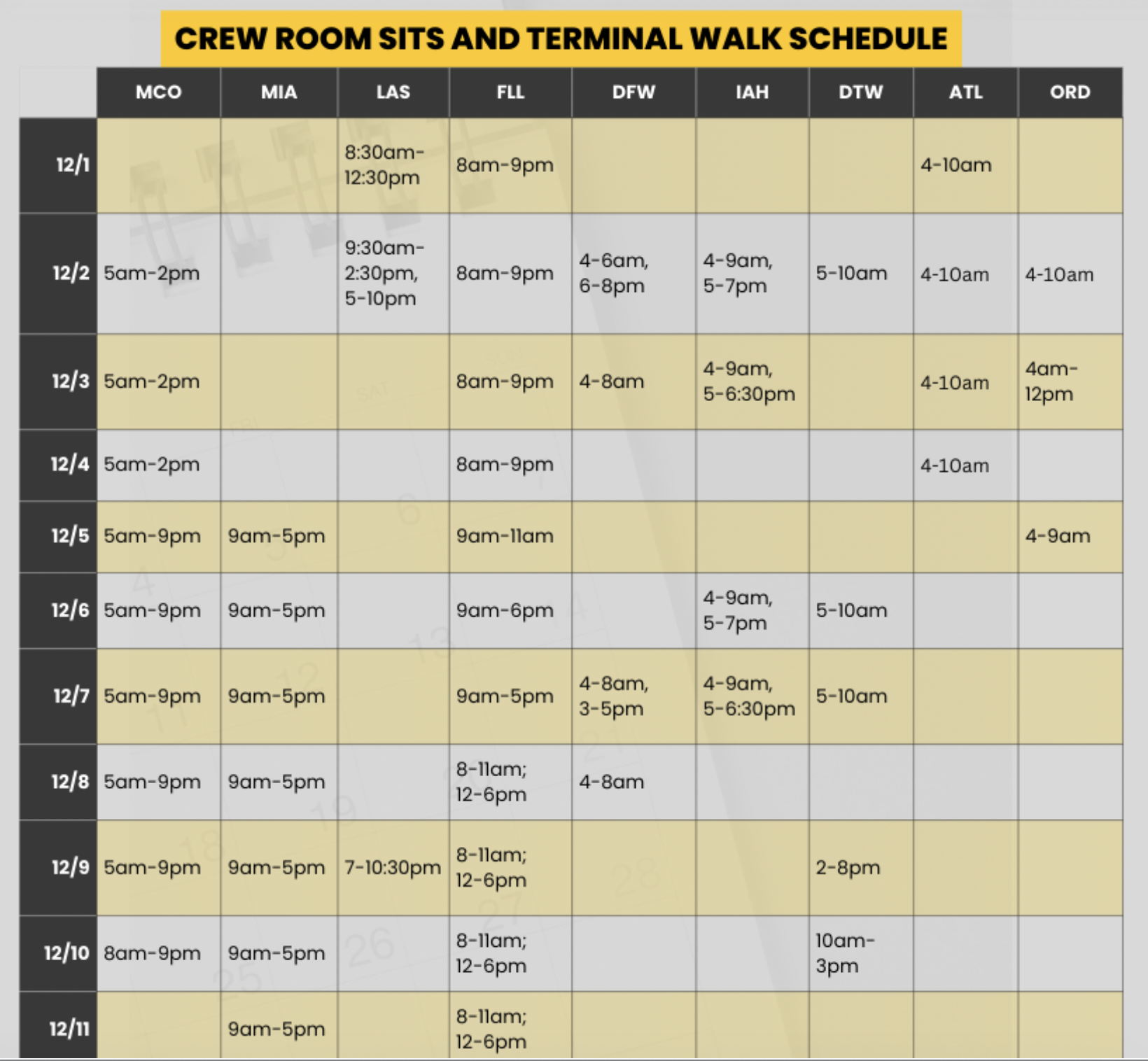
AFA Flight Attendant representatives will be available in person in the crew rooms or other high traffic airport areas in our bases. Check out this schedule for crew room sits and terminal walks throughout the voting period, December 1 through December 11. Take advantage of talking with someone directly about the LOA and get your questions answered. If your question is one the representative hasn’t heard before, they will take your information and get the answer then follow up directly with you.
The vote will open on December 1 at 12pm ET and close on December 11 at 12pm ET. This is a compressed time period for voting due to the financing requirements Spirit must meet in order to continue operations. Your Spirit AFA MEC recommends a vote FOR this agreement to keep control of our contract in Flight Attendants’ hands, preserve base wages, healthcare, and lock in snapbacks for all of the cuts.
All active members (actively flying or in the first three months of voluntary leave) in good standing or those on voluntary leave who are dues current will be eligible to vote.
You can view your eligibility in the AFA Membership Hub.
If you’re having trouble logging in, request a Welcome Email to set your password and access your account. Visit: afacwa.org/Hubhelp
If you've been on a voluntary, medical, or other leave for over three months, you must reach out to AFA Membership through this form and pay your dues through December 2025 to be eligible to vote.
Frequently Asked Questions
Structure of the Bankruptcy Required Temporary Cuts
Why implement dates for snapbacks, instead of when the company returns to profitability?
We got a lot of feedback that Flight Attendants preferred hard dates for snapbacks rather than a formula tied to profitability. Through a lot of effort we were able to get the company to agree to modify the snapback language to guarantee all provisions snapped back, regardless of profitability.
Profitability is not guaranteed. Date certain snapbacks mean all concessions will be temporary, and if ratified, our CBA remains intact with full snapbacks. Our new snapback language also mirrors the pilot snapbacks.
Most of us Flight Attendants live on overtime. Why didn’t we negotiate a cap of 110 block hours as we had before?
The company was not interested in negotiating a cap - it doesn’t save the company money.
Can we get a chart with actual numbers? Meaning, please show the actual dollar amounts on how much the company is saving on each section of the contract.
Our financial analyst is able to review and assess management’s numbers on a confidential basis only. The information is proprietary and governed by non-disclosure agreements. This is standard in labor negotiations where the company provides information but does not allow the distribution of costing on particular items because it could be used by business competitors to back into confidential information.
Will yearly raises be given, or is a wage freeze in process?
AFA fought hard to ensure that there is no wage freeze or reduction to wages. Hourly rates based on longevity wage will continue as outlined in Section 3.B.
Are there changes to our insurance?
There are no changes to our insurance as a part of this LOA. AFA fought HARD to keep our insurance intact. The company originally sought $32 million in concessions, including changes to our health insurance. A No vote puts that in significant jeopardy.
Why is our per diem being capped at $2.99?
We needed to get to $15 million worth of cuts. One of the ways we can get to the $15 million is by capping per diem at $2.99 for a period of time. This is our way of minimizing the impact on Flight Attendants as much as possible while getting to the required $15 million.
Why not negotiate other things that will not affect our income, for example Reimbursement of Global Entry, Renewal of passport, Uniform allowance, etc.
Unfortunately, items like these don’t add enough value to the required $15 million cuts – they do not have a big enough impact on the concessions to avoid cuts to the other items in the LOA.
Why not cut the 401(k) match instead of other items such as OT?
Cutting or even eliminating the 401(k) match would not have supplied enough money to meet the $15 million and avoid other cuts such as OT. Additionally, disrupting a retirement plan can produce longer term harm to Flight Attendants, and the 401(k) match is a certainty as opposed to the OT which may or may not be available in an environment such as bankruptcy.
Is it true that the pilots said if they have to get a pay cut, so do we? And if so, why was that even allowed? The pilots make more money than we do. A pay cut for us is horrible compared to them.
No, ALPA did not say that, it is simply the way that bankruptcy works. As part of the bankruptcy process, it is typical for each employee group and all stakeholders to be required to take cuts. Here, the company sought cuts from the pilots which ended up being $85 million. They originally sought $32 million in cuts from us but we were able to get that amount down to $15 million, which represents almost half the value of cuts to our contract as opposed to the value of cuts to the pilot contract. It’s also important to stick together as workers and hold management accountable throughout this process.
Why wasn’t there a consideration for a pay cut like ALPA?
Our efforts in this entire process were to limit the impact of the cuts for Flight Attendants. Pay is guaranteed and flows through to the value of everything else in the contract such as the value of overtime, ground holding time, training pay, vacation, and sick leave. Overtime hours are not guaranteed. Spirit’s restructuring and reduced operations mean that there will likely be fewer and fewer opportunities to earn overtime.
We may not be able to get as much overtime as we are used to earning, but we were able to get the value of current overtime to count toward the required 15 million dollars of temporary concessions. We also prioritized overtime in the snapback schedule and if Spirit recovers hopefully this will coincide with a return of more flying to pick up.
A pay cut, combined with fewer opportunities to earn overtime, would result in less money in our pockets than temporarily eliminating overtime hours alone. Pay ripples through the entire agreement.
LOA Process
What happens if we vote NO?
If we vote down the proposed changes now, the company has fulfilled its obligation for our input and will ask the court to make changes to our CBA. We will not have any say in the changes management makes to our Contract. Management has stated that they will seek changes that also include pay rates, healthcare and are more extensive than the changes outlined in the LOA. AFA will of course fight that in court, but we need to be direct with you about the bankruptcy process that does not favor workers’ needs.
Who proposed these concessions?
The company asked for concessions totaling $32 million. AFA was able to negotiate the company down to $15 million and avoid the changes to our healthcare and base pay that management stated they were originally seeking.
Why wasn’t a survey conducted to gather input before the concessions were considered?
There was simply no time to conduct any kind of survey. ALPA was able to because they were already in active Section 6 negotiations. We had to reach an agreement quickly because there was a deadline to secure continued debtor-in-possession (DIP) financing for Spirit to keep operating.
What was the MEC vote count? 3-2, 4-1, 5-0?
The vote count was 6-0 in favor of the agreement to minimize cuts and keep our contract intact.
If we all agree on these changes, and vote for them, who’s to say the judge will disagree and the company will get to change the contract as they deem necessary and use their special phrase (due to operational needs) and use & abuse us?
It doesn’t work that way. If the LOA is ratified our contract remains in full force and effect. The company will not pursue an 1113 motion to reject our CBA if the LOA is approved.
Is the next bankruptcy date set for Dec. 13? And does the company need to have these labor concessions set by this time to access additional creditor financing?
There are certain funding dates the company must meet throughout the bankruptcy process.
These dates are essentially checkpoints with financial benchmarks that the creditors use to evaluate whether Spirit has restructured enough debt and cost obligations to continue operating. December 13th is the next date the creditors will decide whether they are confident enough to keep funding.
Will Spirit be a part of a merger in the future?
We don’t know right now. Things change very quickly in a bankruptcy. When Spirit emerges from bankruptcy, it will have half the debt and lower operational costs, meaning it will be much cheaper to acquire the company. A merger may be the only way for Spirit to survive. However, Spirit must still be able to operate on its own while the merger is implemented.
Why are there no clauses for contract protections in case of a merger/acquisition?
We cannot go into one of these with our concessions. We have merger protections in our CBA, Section 1, Recognition and Job Security. That Section includes Scope language protecting our right to Spirit flying, successorship language requiring an acquiring or merging partner to assume our agreements, and merger protections. All of these will be in full force and effect with the approval of the LOA.
This agreement includes limited cuts but also now includes firm date snap backs, which means that all of the concessions are temporary and each item is still technically in our contract. Together with our scope and successor protections discussed above, that places us on the best possible footing entering a merger. Protecting our base pay and health care would allow us to enter into potential merger discussions from a higher level rather than after deep cuts.
Bankruptcy Process
Introduction
Bankruptcy allows companies to reorganize, and a central part of that process is the ability of a company to break or abrogate contracts when it declares it cannot continue operating under its current obligations. To alter or abrogate a collective bargaining agreement, the company must follow the steps in Section 1113 of the Bankruptcy Code.
What is Section 1113?
Section 1113 is the bankruptcy rule that governs how a company can seek changes to a union contract. Before going to court, the company must make a written proposal, provide financial information to support that proposal, and meet with the union to bargain in good faith. Once the company completes those steps, it can file a motion asking the court to approve the changes if the union and company are not able to reach an agreement.
What standards does the judge apply?
The judge reviews three legal standards, but which offer limited protection for the union.
First, the company’s proposal must be “necessary” for the reorganization. Courts interpret “necessary” broadly. It does not mean the employer’s proposal is the only or least burdensome to employees but rather it is needed for the reorganization.
Second, the proposal must be “fair and equitable,” but this does not require treatment be exactly the same among all groups. It’s also important to note that this means it must treat the debtor, creditor and other parties fairly and does not mean it will be what we would consider fair from a frontline worker perspective. In fact, quite the opposite.
Third, the company must bargain with the union. This does not mean it needs to agree with the union or even lower its overall ask. The company must share info with the union and be responsive to alternatives but the court is not wading into the substance of any negotiations. Overall, the bankruptcy process is set up to allow companies to shed contracts and that includes labor contracts. Our experience and that of other unions is that the bankruptcy courts are employer friendly overall which is why we push to reach a consensual agreement we can shape.
Where are we at in the process?
Spirit met with Flight Attendants and complied with the provisions of 1113. Their initial plan was to seek over $32 million dollars from Flight Attendants but with the assistance of finance and bankruptcy experts we were able to get that amount down to $15 million. We were able to reach an Agreement in Principle which limits the impact of the concessions, and includes firm snapbacks and other protections. That agreement is now subject to your vote.
What happens after the vote on the Agreement?
If the LOA is approved it becomes effective on January 1, 2026. This affirms our contract is in full force and effect, including the snapback of the temporary cuts.
If the Agreement does not ratify, the company has indicated that they will file an 1113 motion in the court to abrogate our collective bargaining agreement and ask the court to approve their plan for cuts to the contract. That means that they will likely go to court seeking the original $32 million in cuts without snapbacks.
We would anticipate this would come pretty quickly following the rejection of the Agreement. The statute provides that a hearing will be held within fourteen days of the 1113 motion. Things move very fast in bankruptcy.
Will we get to bargain for a new bankruptcy agreement?
As stated above, the company will move its 1113 motion and at this point the bankruptcy court will take over. There will not be the opportunity to fashion a new agreement in principle and go through another ratification process. Additionally, since the company will likely be proposing more cuts than in any rejected agreement, our efforts would be to try to limit the damage.
What happens if the judge grants the motion?
If the judge approves the motion, the company can impose the exact terms of its final 1113 proposal. The union remains the representative, and bargaining continues, but the day-to-day working conditions shift to the company’s imposed terms. After that point, it is much more difficult to regain what was lost because the imposed terms become the new baseline.
What happens if no agreement is reached before the hearing?
If bargaining does not produce an agreement, the judge can only approve or deny the company’s request. The judge cannot write a compromise or pick the parts they think are reasonable. If the judge approves the motion, the company gains the ability to impose its full proposal. This is why understanding Section 1113 is important when Flight Attendants consider whether to accept or reject the LOA.